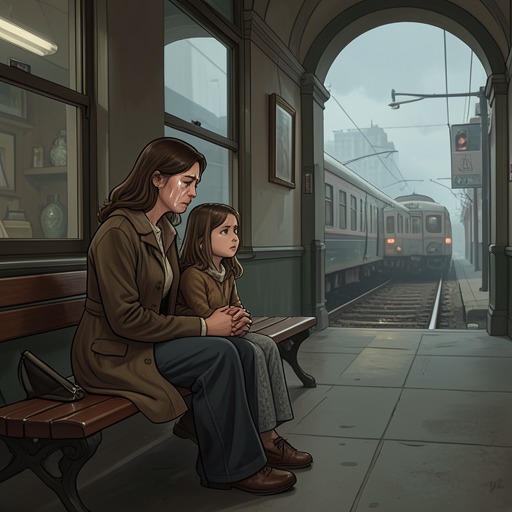
Ilana
Here There Is No WhyIlana is Judah Loeb’s older sister and Stan’s wife, but her decisive importance lies in the practical and moral labor she performs for Judah and Hannah after Mary’s suicide. She is the family member who turns grief into immediate action: she takes Hannah away from Judah’s collapse, forces him into rehabilitation, organizes his return to ordinary life, and later insists that he tell Hannah about his book on Chaim Lerner. Her profanity, fury, and dark humor are not signs of indifference. They are the language through which she protects the living from another person’s unexamined trauma.
Identity and Family Position
Ilana belongs to Judah’s closest family circle through two simultaneous bonds: she is his sister, and she is married to Stan, his agent and former friend from Cleveland Heights High School. When the Bob Dylan project collapses, Stan argues that Judah must accept the Lerner book, and Ilana becomes the person whose approval cannot be bypassed. Stan offers to speak to her and to have Hannah stay with the couple while Judah travels to Israel, recognizing that Ilana’s household is already the practical refuge on which the plan depends.
Her relationship with Judah is intimate enough to contain mockery, rebuke, and difficult memory. When she calls after reading the proposal, she does not respond as an editor or business partner. She responds as the sister who knows what suicide has done to the family. The low, whispery voice she uses when angry is more ominous to Judah than her ordinary swearing, because it signals that her humor has disappeared. Her anger is therefore rendered as a form of knowledge: she understands that the proposed book is not merely about Chaim Lerner’s death but about a wound that still governs Judah’s life.
Care After Mary’s Suicide
Ilana’s history with Judah is defined by intervention after Mary’s death. Judah found Mary’s body with their five-year-old daughter, Hannah, and then drank himself into a prolonged haze. Ilana and Stan took Hannah away before Judah could cause what the narrative describes as irreparable harm. Ilana brought him to rehabilitation not once but three times, and after he had lost twenty pounds and remained sober for a month, she arranged for Judah and Hannah to move into the couple’s home in Scarsdale.
During the year they lived together, Ilana managed the ordinary structures Judah could no longer manage for himself. She made sure he showered, dressed, and went to work at The Times. For the first month, she walked him to the train station because she feared he might get lost. She researched therapists and drove both Judah and Hannah to their appointments, knowing that Judah could not be trusted to attend on his own. Her care is concrete rather than sentimental: transportation, schedules, hygiene, employment, treatment, and childcare become the scaffolding of recovery.
She also provides the one form of listening Judah cannot find elsewhere. He can describe Mary’s grotesque body to Ilana, repeat his self-pitying theories about why Mary acted as she did, and search for an explanation for the absence of a suicide note. Ilana listens even though she already understands the reasons for Mary’s death and is tired of explaining them to him. Her patience has a limit, but that limit does not cancel the earlier labor. It explains why suicide is not an abstract topic for her and why Judah’s proposed book immediately feels like a threat to the fragile order she helped create.
Conflict Over the Lerner Book
When the Dylan book falls through, Judah tells Stan that he cannot afford to reject the Lerner project. He also admits that the suicide is not a minor component but the reason for writing the book. The financial choice becomes an ethical and familial crisis: Judah must travel to Israel, while Ilana must absorb the consequences by caring for Hannah and helping her understand why her father is leaving.
Ilana’s response is blunt because she refuses Judah’s attempt to minimize the subject. She has read the proposal, understands that it concerns a writer who committed suicide, and rejects the language of a “minor part.” Judah asks whether Hannah can stay with her, promising that he should be away no more than two weeks. Ilana agrees, but only after imposing a condition: Judah must tell Hannah. The demand prevents him from converting his daughter’s family history into material that can be investigated elsewhere while remaining concealed at home.
Her exchange with Judah also exposes a difference between them. Judah approaches suicide through professional curiosity, theory, and the possibility of a book; Ilana approaches it through bodily memory, childcare, addiction, and the daily work of preventing a surviving child from being abandoned again. She does not forbid the project. Instead, she insists that its first obligation is personal truth. Her final profanity sounds, to Judah, like the affectionate kind, but its tenderness is earned by the severity of everything she has already done.
Protection, Judgment, and the Wider Network
Ilana’s influence extends beyond Judah’s immediate crisis. Hannah later tells Judah that Ilana explained how some people confuse anti-Zionism with anti-Semitism. That detail shows Ilana functioning as a political and interpretive guide within the family. She helps Hannah formulate a public description of her views, suggesting that Hannah say she is pro-Palestinian rather than announce herself as anti-Zionist. Ilana therefore mediates not only grief but also the political language through which Hannah will move among questions of Israel and Palestine.
Her protective role contrasts with the silences surrounding Chaim Lerner’s behavior. Chaim’s wife, Zehava, describes his affairs with graduate students, his violent treatment of her, and his repeated sexual advances toward Michal. Michal recalls that adults often saw Chaim’s conduct and looked away, a social silence reinforced by the fact that this was not yet the #MeToo era. Ilana is not present in those scenes, but her position in the novel’s family structure provides a counterexample to that evasive pattern: when Judah tries to soften the suicide material, she names the danger directly; when Hannah needs care, she takes responsibility rather than looking away.
Ilana’s care is also deliberately imperfect. She swears, shouts, loses her humor, and makes Judah confront what he would prefer to classify as a professional problem. Yet the narrative refuses to separate her anger from her love. Her harshness is the visible edge of a sustained commitment to Judah and Hannah, while her household becomes the place where survival is made possible through repetition and routine.
Narrative Significance
Ilana anchors the book’s investigation of suicide in its aftermath rather than in the death alone. Mary’s suicide is not merely Judah’s backstory; it produces addiction, interrupted parenting, rehabilitation, displacement, and a new domestic arrangement in Scarsdale. Ilana is the agent of that transition, converting catastrophe into a series of acts that can be performed again tomorrow.
She also exposes the danger of treating trauma as detachable material. Judah wants to write about Chaim Lerner’s death because he believes the suicide is the book’s true subject, but Ilana reminds him that every such investigation touches people who must continue living after the author leaves. Her condition that he tell Hannah makes disclosure part of the book’s moral structure. It binds public storytelling to private responsibility.
In this sense, Ilana is neither simply a supporting relative nor a voice of conventional judgment. She is the family’s practical memory: she remembers what happened to Judah, knows what Hannah was exposed to, and recognizes the difference between a theory about suicide and the work required to keep a suicidal history from repeating itself. Her decisive act is not a dramatic revelation but an insistence on care, truth, and accountability before interpretation.